Research.

National Geographic- Deforestation explained

BY CHRISTINA NUNEZ PUBLISHED FEBRUARY 7, 2019

https://www.nationalgeographic.com/environment/global-warming/deforestation/

Human-driven and natural loss of trees—deforestation—affects wildlife, ecosystems, weather patterns, and even the climate.

Forests still cover about 30 percent of the world’s land area, but they are disappearing at an alarming rate. Between 1990 and 2016, the world lost 502,000 square miles (1.3 million square kilometers) of forest, according to the World Bank—an area larger than South Africa. Since humans started cutting down forests, 46 percent of trees have been felled, according to a 2015 study in the journal Nature. About 17 percent of the Amazonian rainforest has been destroyed over the past 50 years, and losses recently have been on the rise.

We need trees for a variety of reasons, not least of which is that they absorb not only the carbon dioxide that we exhale, but also the heat-trapping greenhouse gases that human activities emit. As those gases enter the atmosphere, global warming increases, a trend scientists now prefer to call climate change.

The Amazon is losing the equivalent of nearly one million soccer fields of forest cover each year, much of which is cut down to make way for agriculture. When forest is lost, the carbon it sequestered ends up in the atmosphere, accelerating climate change.

Bunches of oil palm fruit are harvested by hand and then trucked to a mill in mainland Malaysia, where they are processed. Ancient forests around the tropics are being cut down to make space for palm oil plantations. When these forests are lost, the carbon they held locked up in their tissues is released into the atmosphere, contributing to further global warming.

The western U.S. has been locked in a drought for years. The dry, hot weather has increased the intensity and destructiveness of forest fires.

The Scherer power plant in Juliet, Georgia, is the largest coal-fired power plant in the U.S. It burns 34,000 tons of coal daily, pumping over 25 million tons of carbon dioxide into the atmosphere each year.

Causes of deforestation:

Farming, grazing of livestock, mining, and drilling combined account for more than half of all deforestation. Forestry practices, wildfires and, in small part, urbanization account for the rest. In Malaysia and Indonesia, forests are cut down to make way for producing palm oil, which can be found in everything from shampoo to saltines. In the Amazon, cattle ranching and farms—particularly soy plantations—are key culprits.

Logging operations, which provide the world’s wood and paper products, also fell countless trees each year. Loggers, some of them acting illegally, also build roads to access more and more remote forests—which leads to further deforestation. Forests are also cut as a result of growing urban sprawl as land is developed for homes.

Not all deforestation is intentional. Some is caused by a combination of human and natural factors like wildfires and overgrazing, which may prevent the growth of young trees.

Why it matters and what can be done:

Deforestation affects the people and animals where trees are cut, as well as the wider world. Some 250 million people living in forest and savannah areas depend on them for subsistence and income—many of them among the world’s rural poor. Eighty percent of Earth’s land animals and plants live in forests, and deforestation threatens species including the orangutanSumatran tiger, and many species of birds. Removing trees deprives the forest of portions of its canopy, which blocks the sun’s rays during the day and retains heat at night. That disruption leads to more extreme temperature swings that can be harmful to plants and animals.

In terms of climate change, cutting trees both adds carbon dioxide to the air and removes the ability to absorb existing carbon dioxide.

The numbers are grim, but many conservationists see reasons for hope. A movement is under way to preserve existing forest ecosystems and restore lost tree cover. Organizations and activists are working to fight illegal mining and logging—National Geographic Explorer Topher White, for example, has come up with a way to use recycled cell phones to monitor for chainsaws. In Tanzania, the residents of Kokota have planted more than 2 million trees on their small island over a decade, aiming to repair previous damage.

For consumers, it makes sense to examine the products and meats you buy, looking for sustainably produced sources when you can. Nonprofit groups such as the Forest Stewardship Council and the Rainforest Alliance certify products they consider sustainable, while the World Wildlife Fund has a palm oil scorecard for consumer brands.
Standard
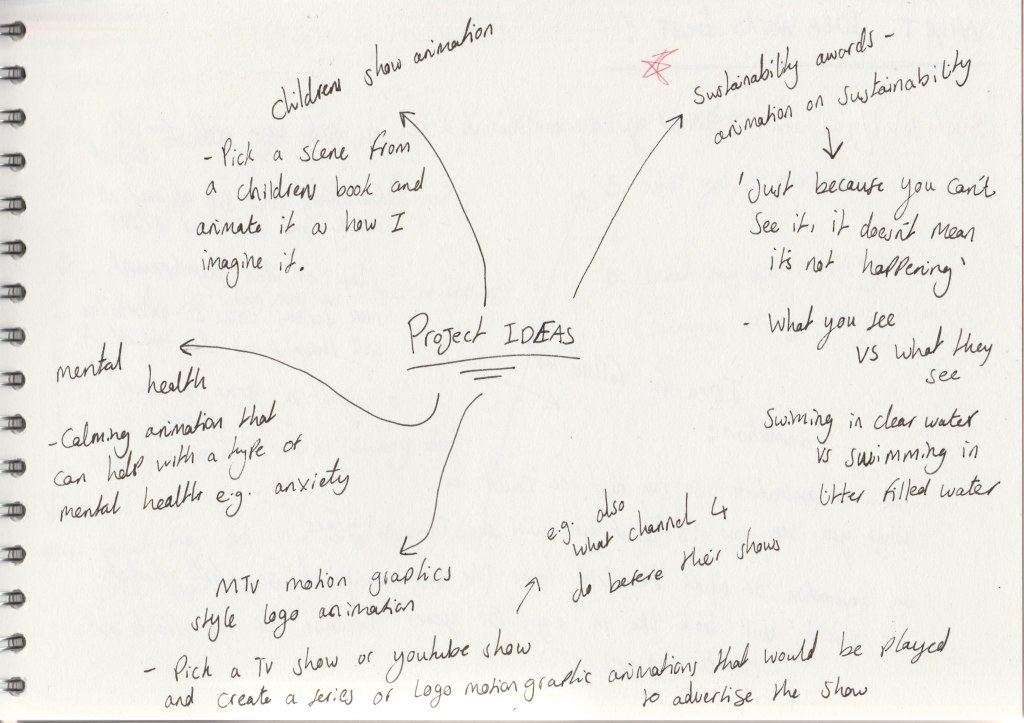
Idea

Idea

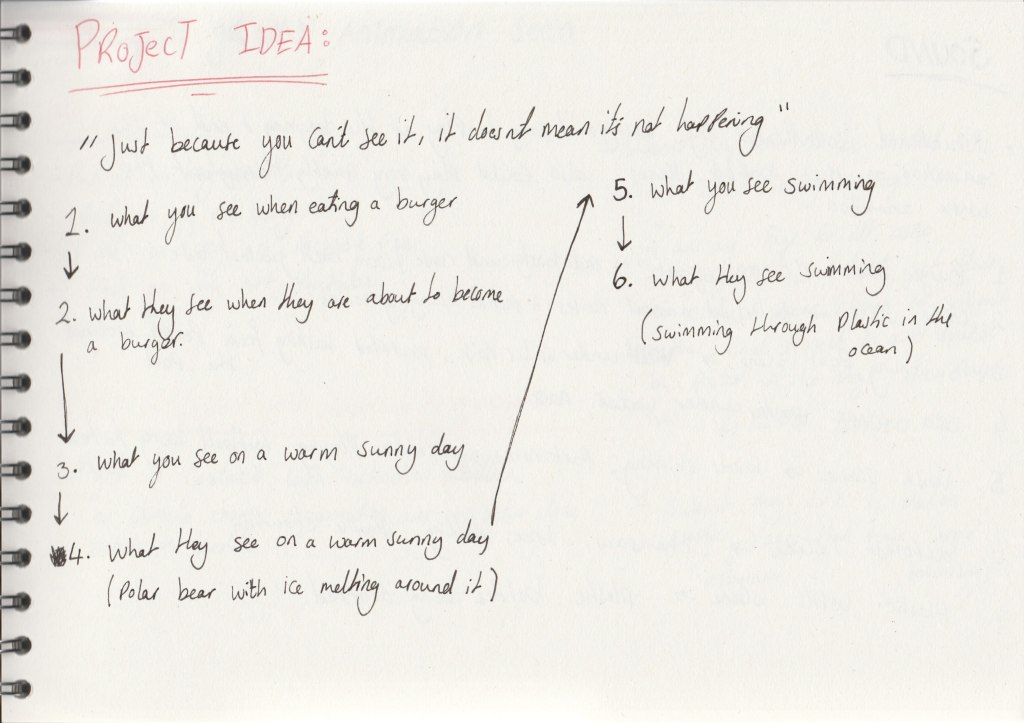
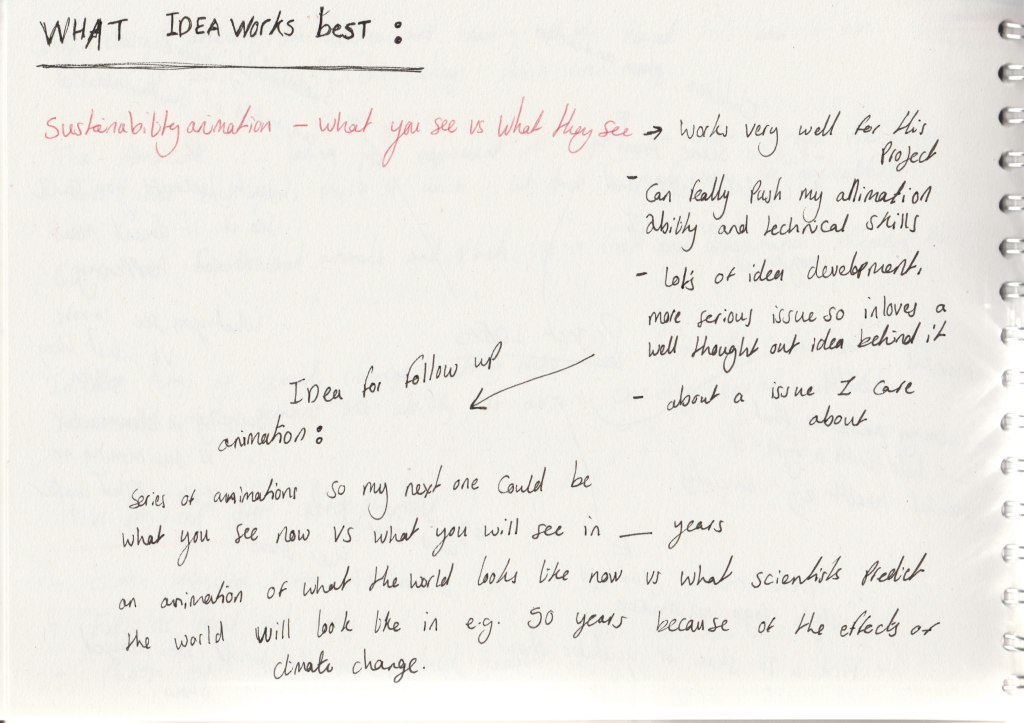
I wrote the brief myself, after brain storming a couple of brief ideas I chose it because it’s about a topic i’m passionate about (climate change) and the brief gives me room to be creative about my animation. In past projects I have picked briefs that involve less of a serious talking point so with this brief I can demonstrate that I am also able to communicate serious issues as well as light hearted ones.

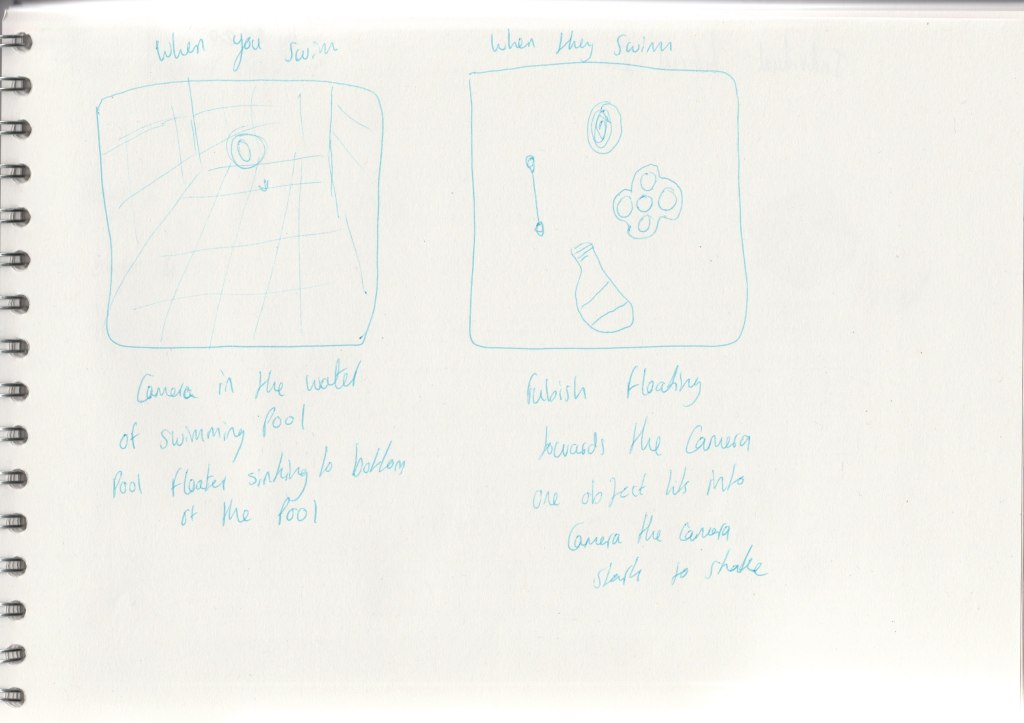
I originally wanted the animation to cover the topics of the animal food production industry (more specifically factory farms), Ice caps melting and deforestation. I made a few rough sketches of how each scene would look.

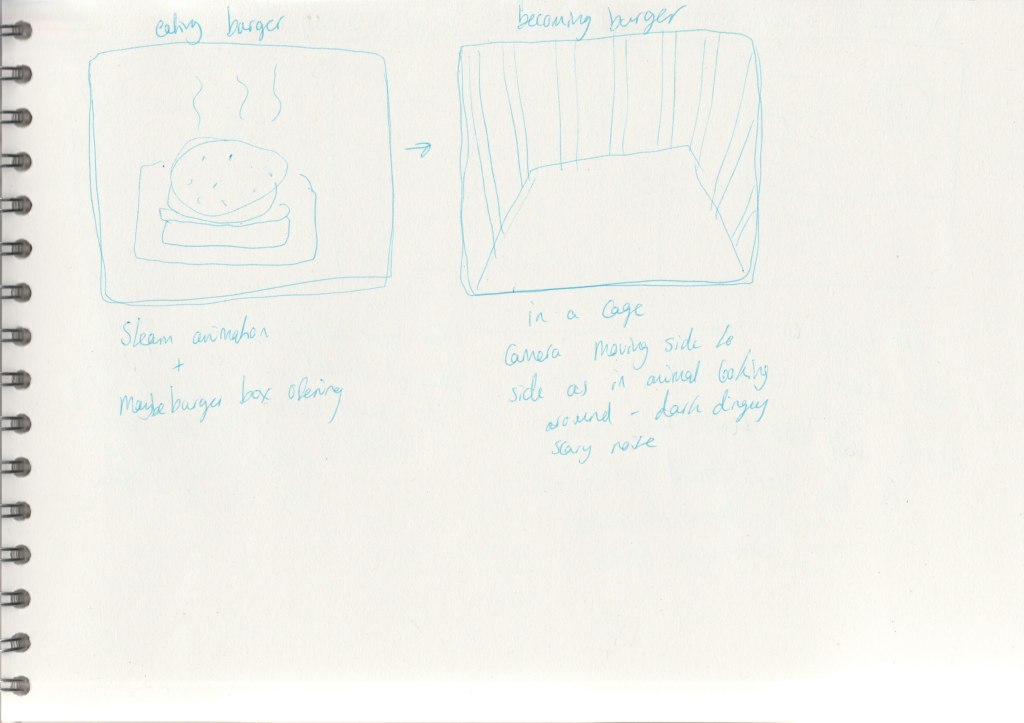
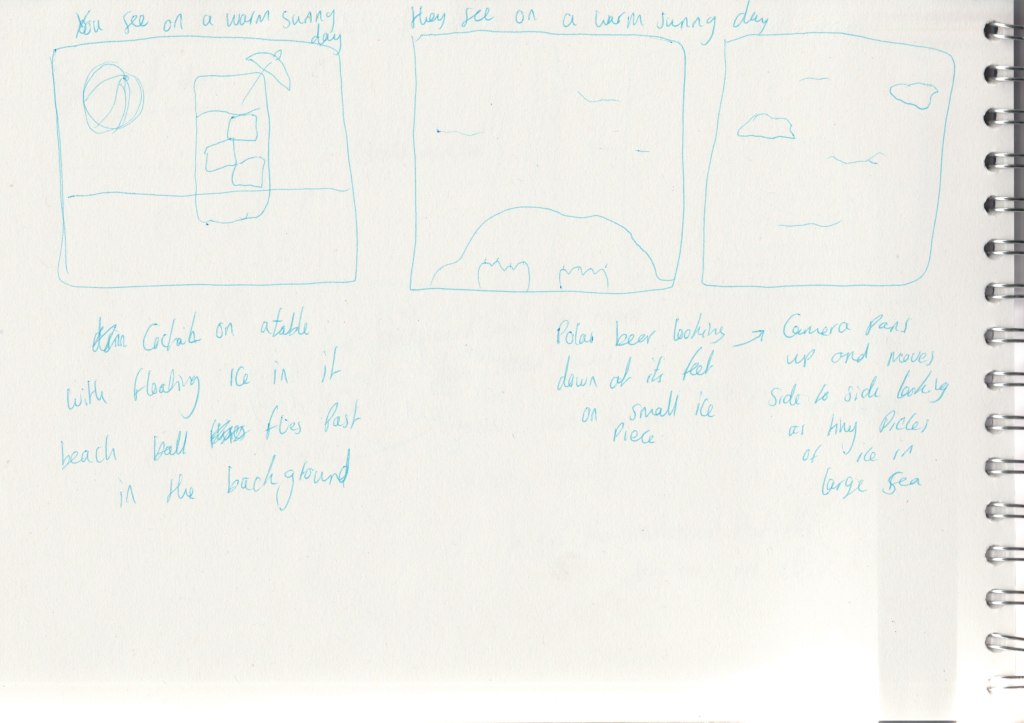
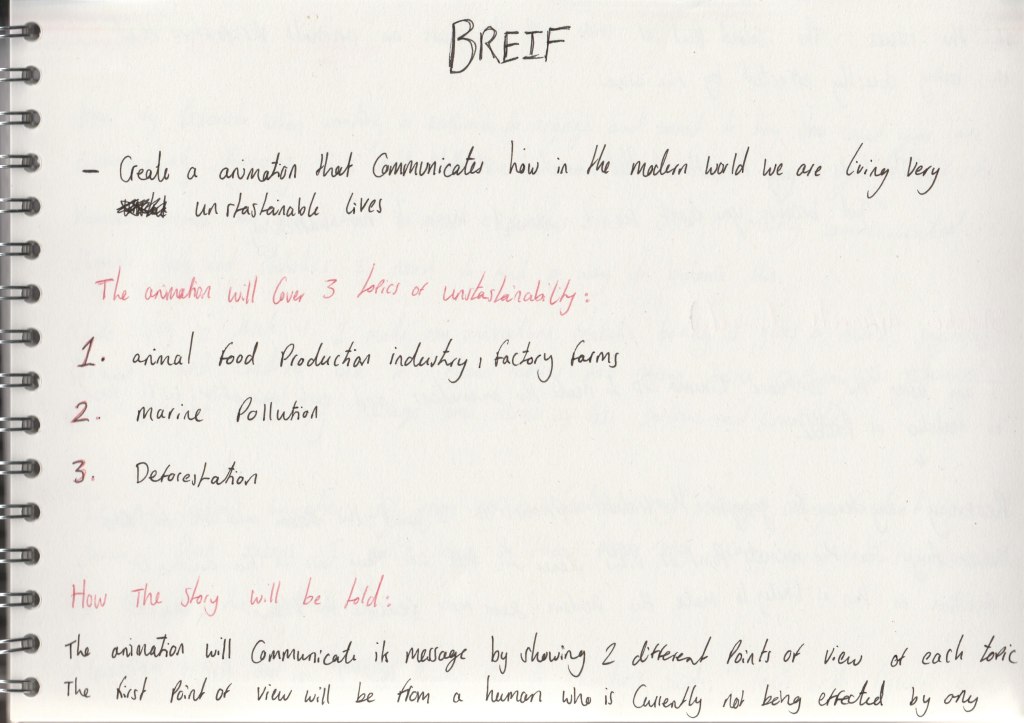
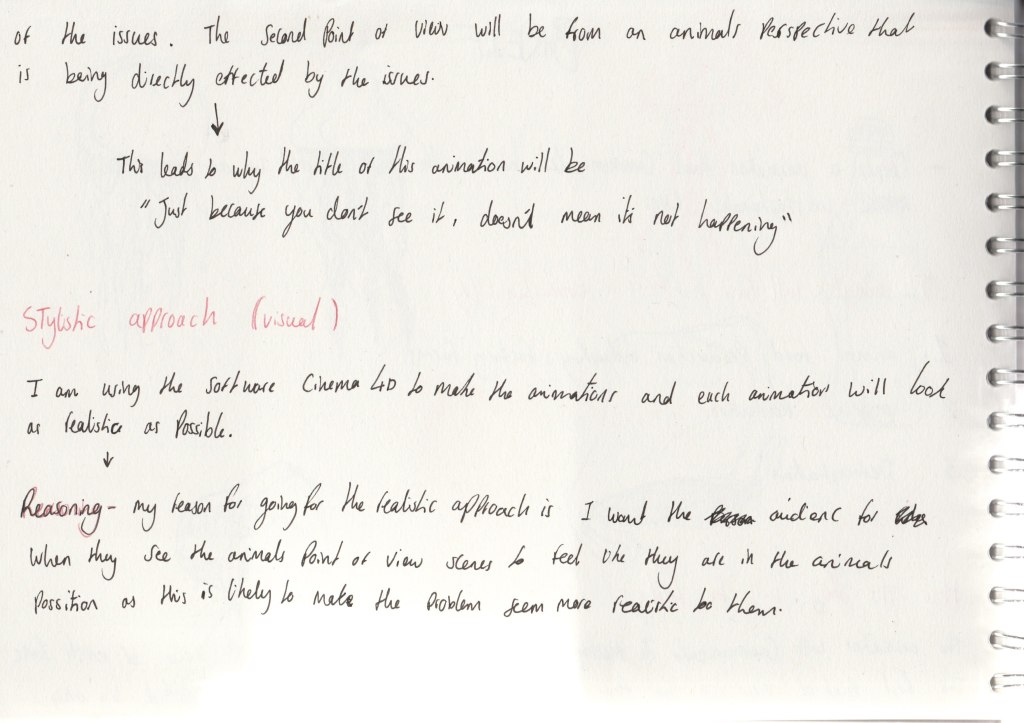
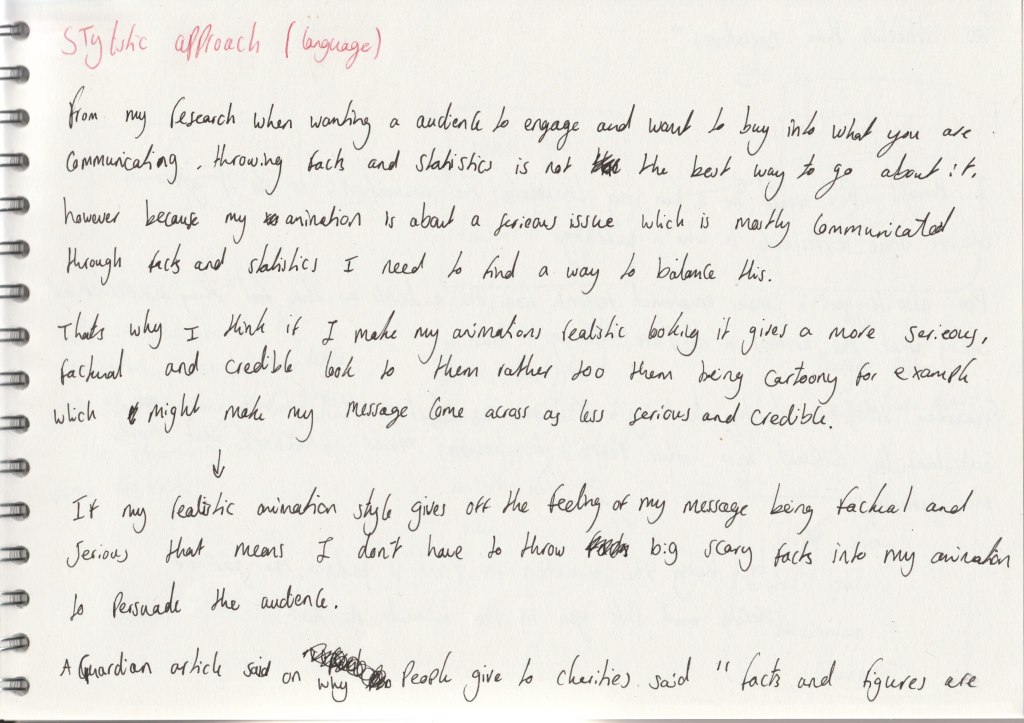
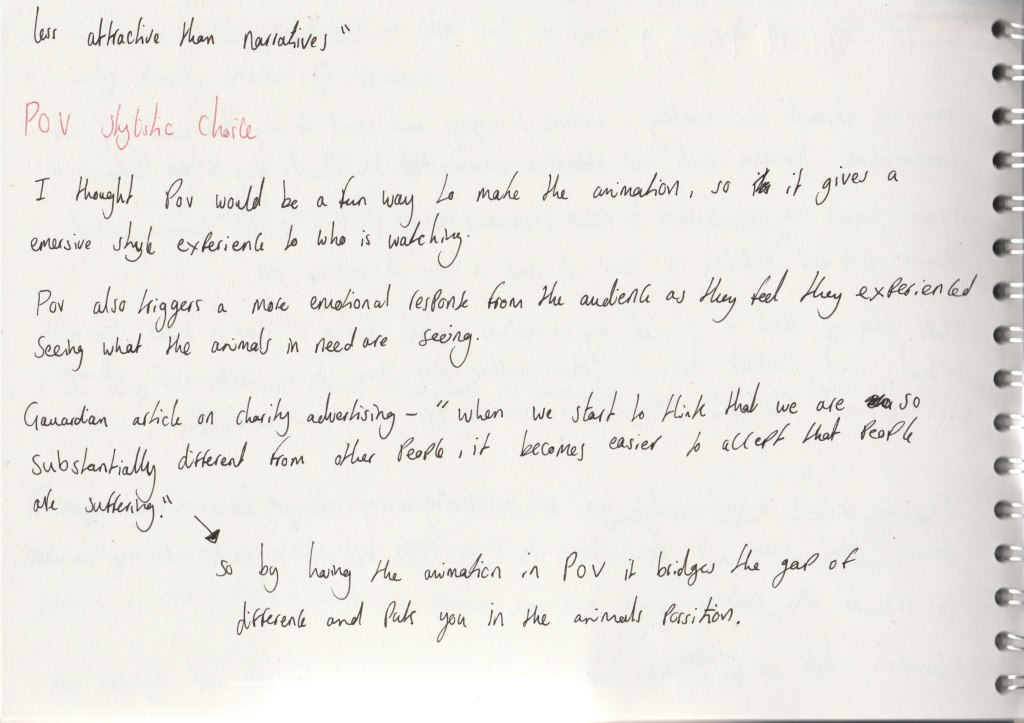
I changed ice caps melting to deforestation because my plan for the ice caps scene was going to involve the sea but I already had the sea and swimming pool scene so by doing deforestation I would show a larger range of my skills as I could show I can create realistic looking trees and a woods like scene. The images of my sketchbook pages below show my explanation of choosing the point of view camera style and how I chose to communicate my sustainability message in the animation.

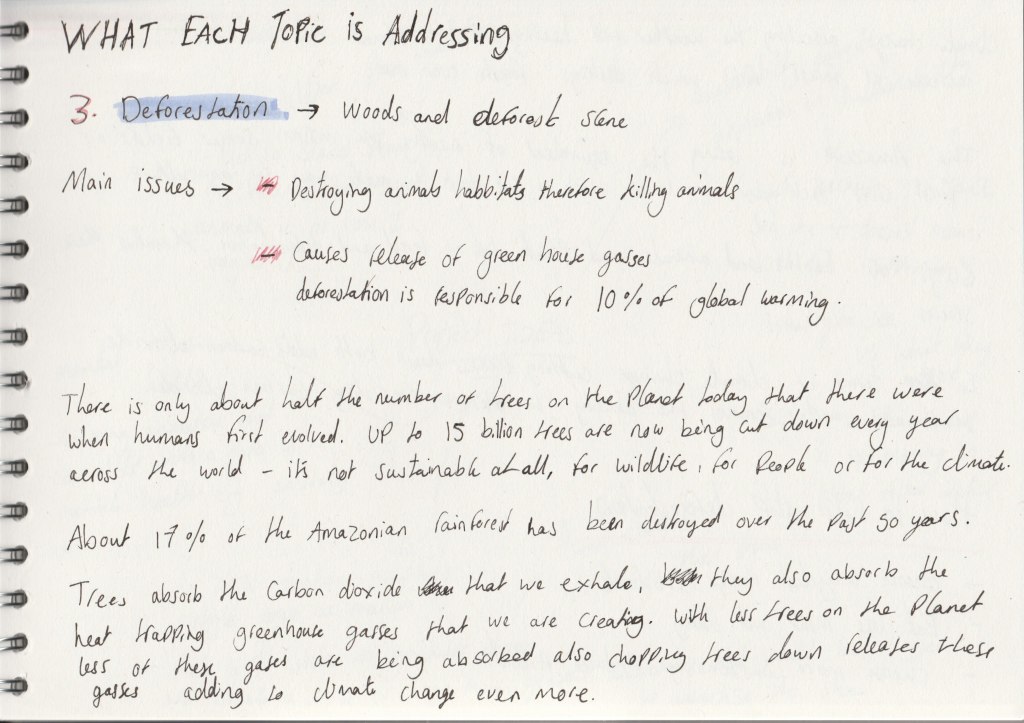
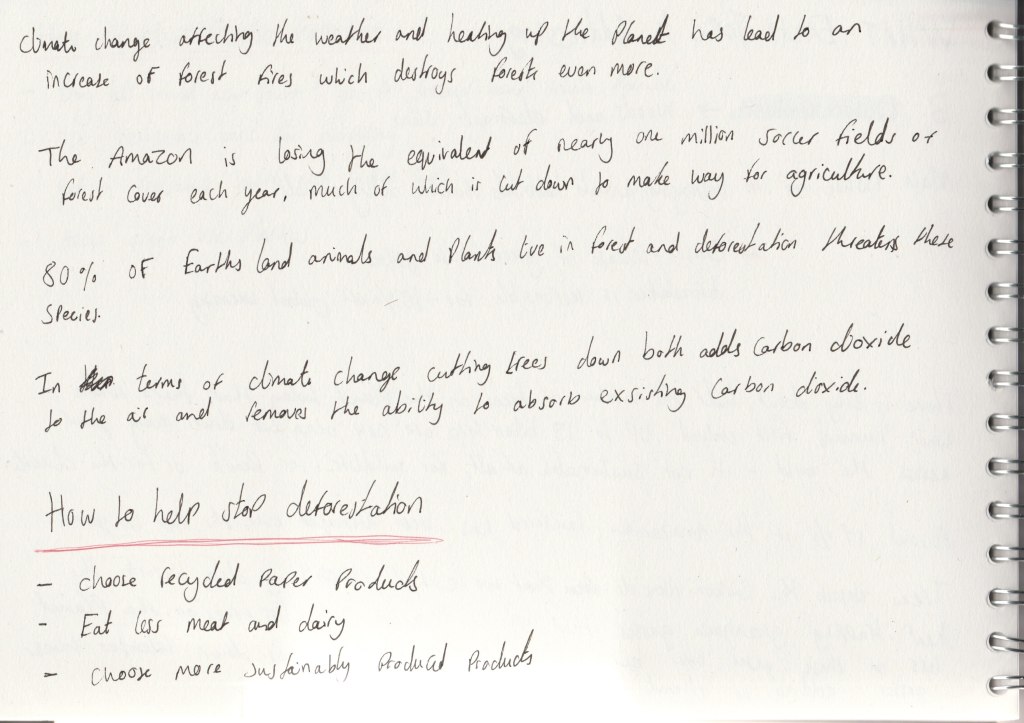
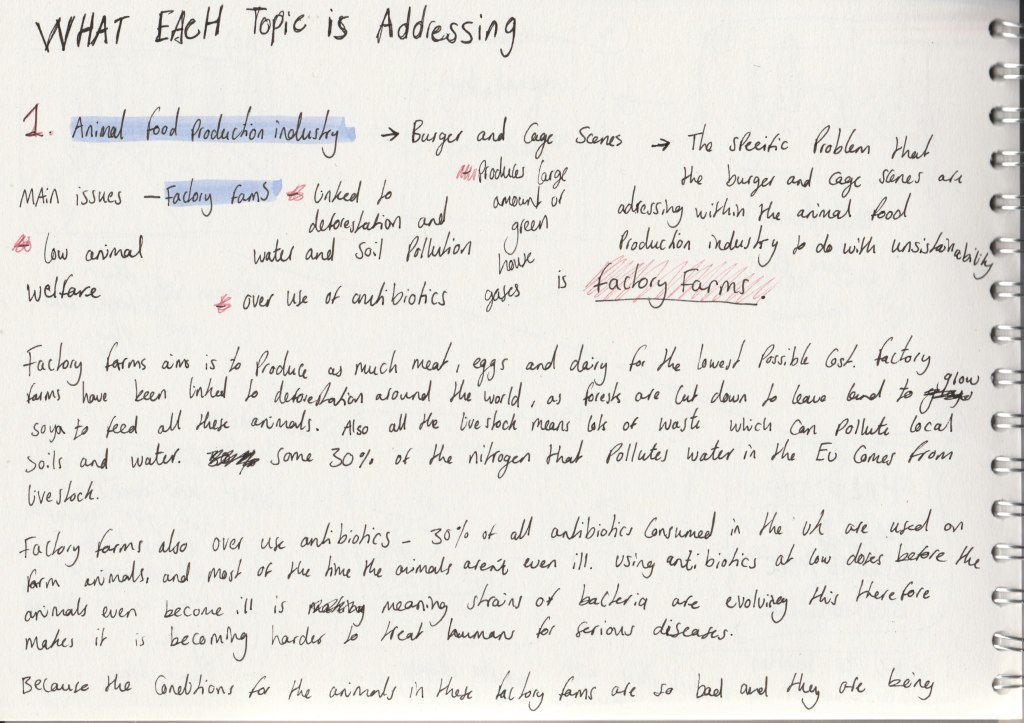
I researched into each topic I am involving in the animation. Knowing what the biggest problems are for the planet that each topic causes informed me if I needed to change how any of my scenes would look. At the end of my animation I wanted to give advice on how to live more sustainably because I don’t just want the animation to seem like a piece to scare people, I want it to be a helpful video to watch.

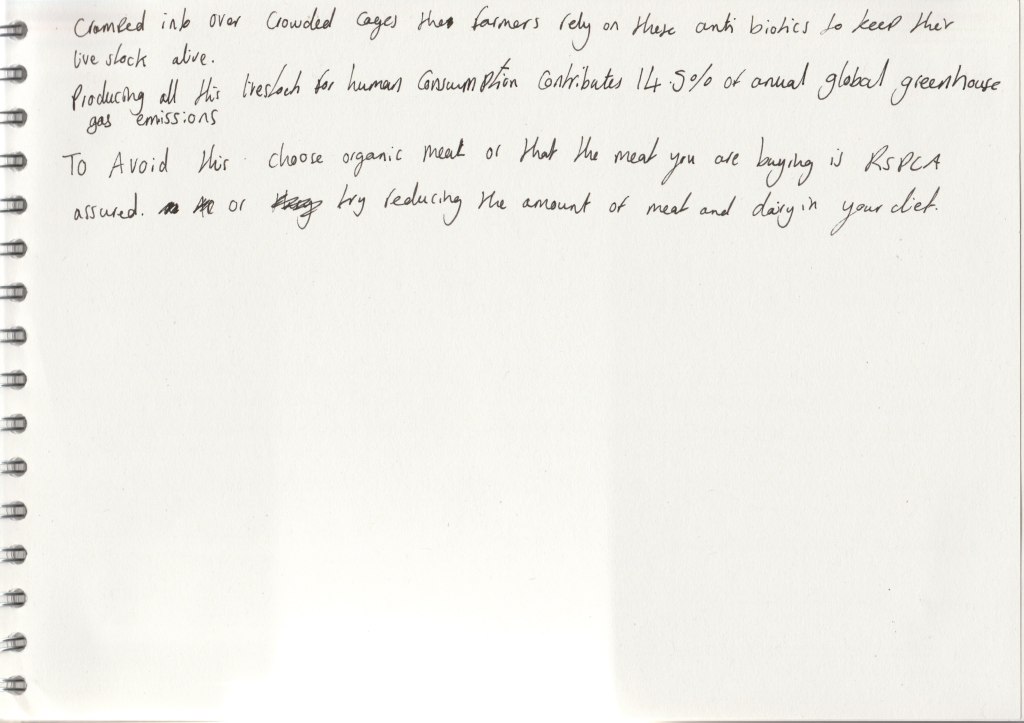
I picked factory framing because diet is something that is easily changed or slightly adjusted so for people it doesn’t seem like its something impossible to do so they are more willing to act. Also factory farming is a big contribute to climate change. It also is a topic that is being talked a lot about at the minuet, many restaurants and food places are adding more vegan and vegetarian items to their menu so it seems like people are open and willing to change their diets now more than before.

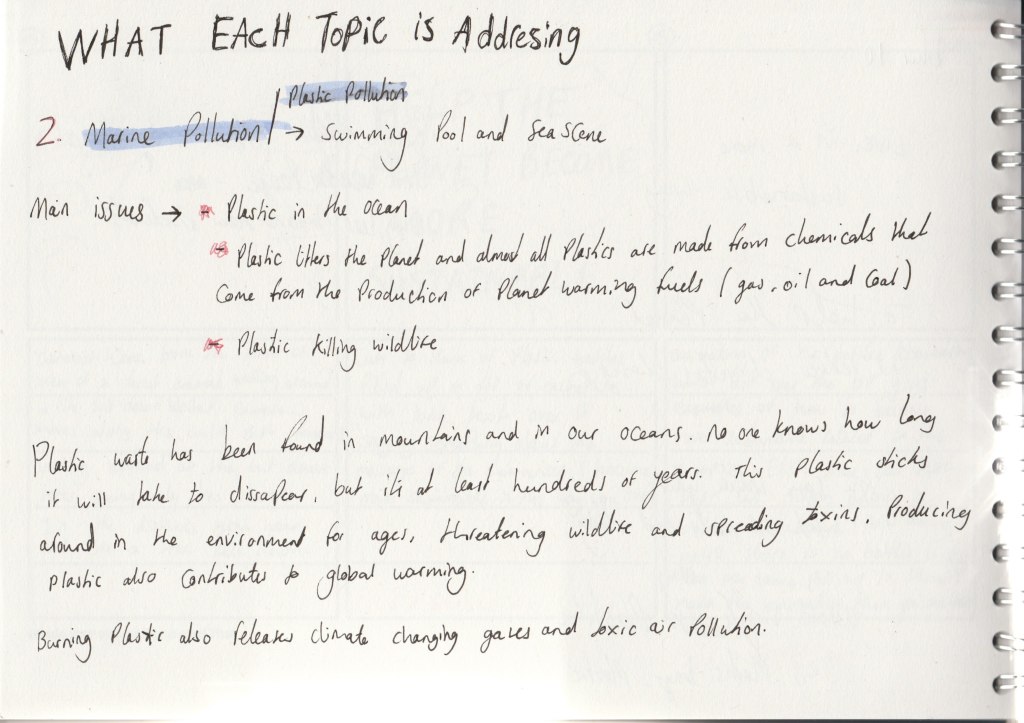
I picked Marine pollution because it is also a topic that has been talked a lot about recently. It’s plastic that is ending up in our oceans that is polluting them and plastic is something that is used so much in peoples daily lives. We really need to reduce our use of plastic and there is very simple and easy ways to do this. By making people more aware of how much plastic they use and if they respond in a way of them reducing their use of plastic would be very beneficial to the planet.

Also I wanted the challenge of creating a under water scene as I had never done this before.

I picked deforestation because it also links well and shows the effects of what the animal food industry causes. Trees are needed to soak up carbon dioxide and other green house gasses so we need more trees to reduce global warming but instead we are cutting them down. Not only is cutting trees down releasing more greenhouse gasses into the environment but it’s destroying animals habitats too.

Images below are of my research into each topic from my sketchbook:

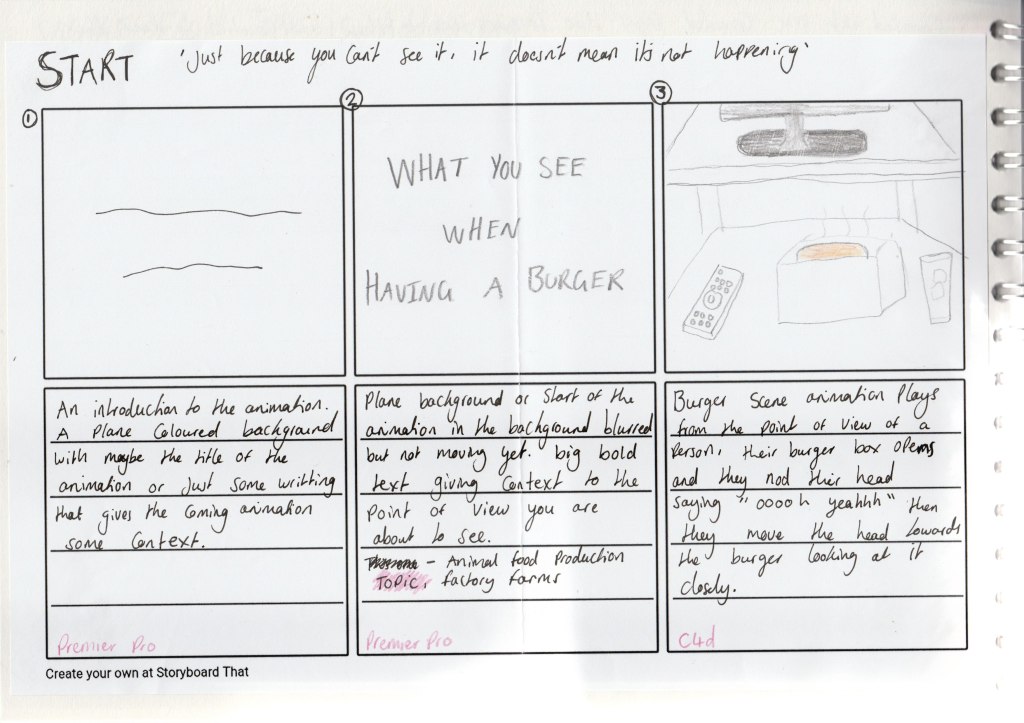
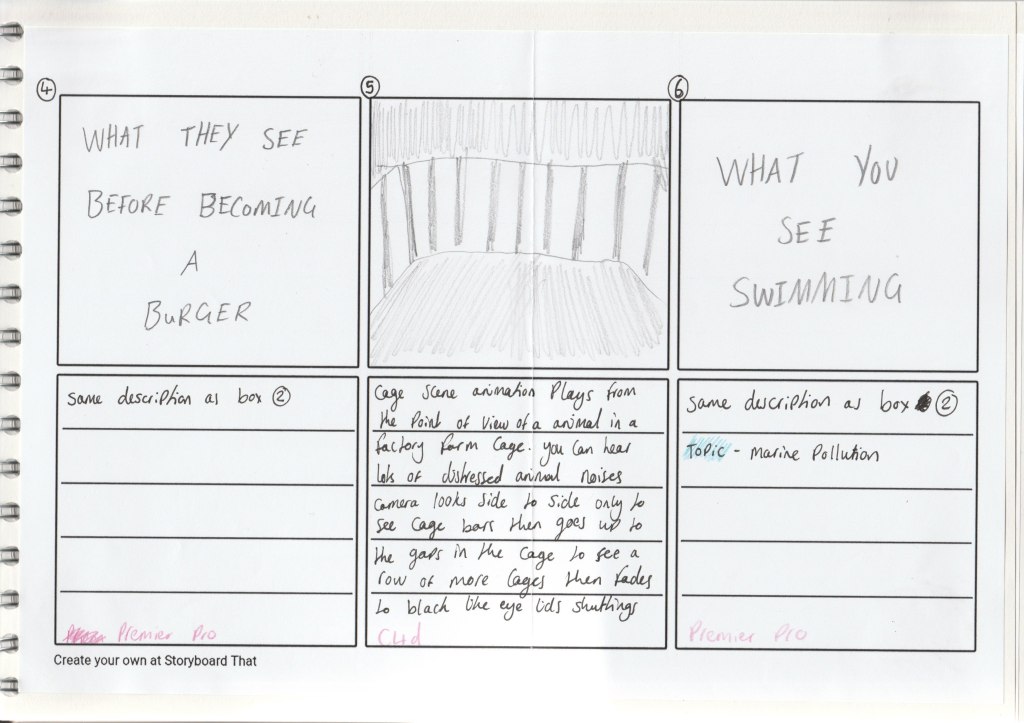
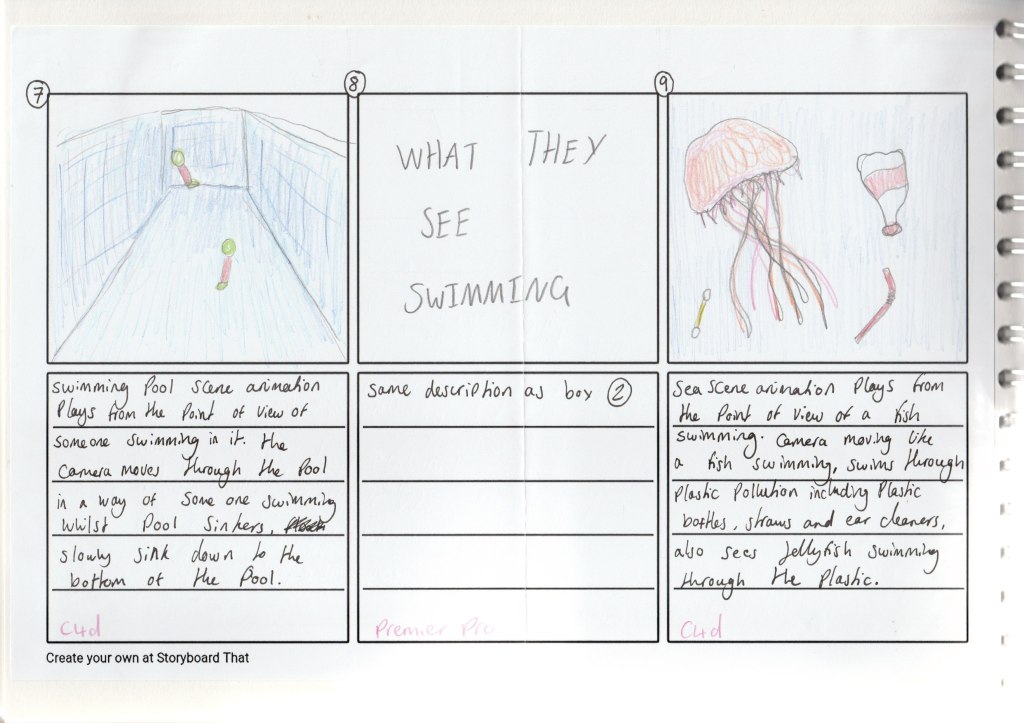
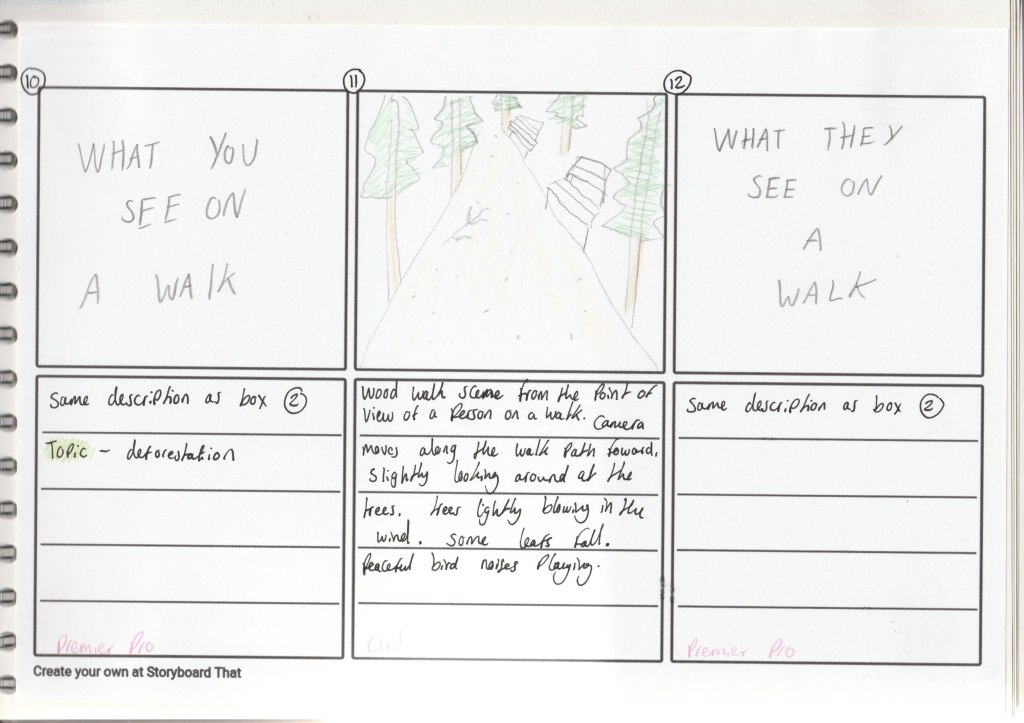
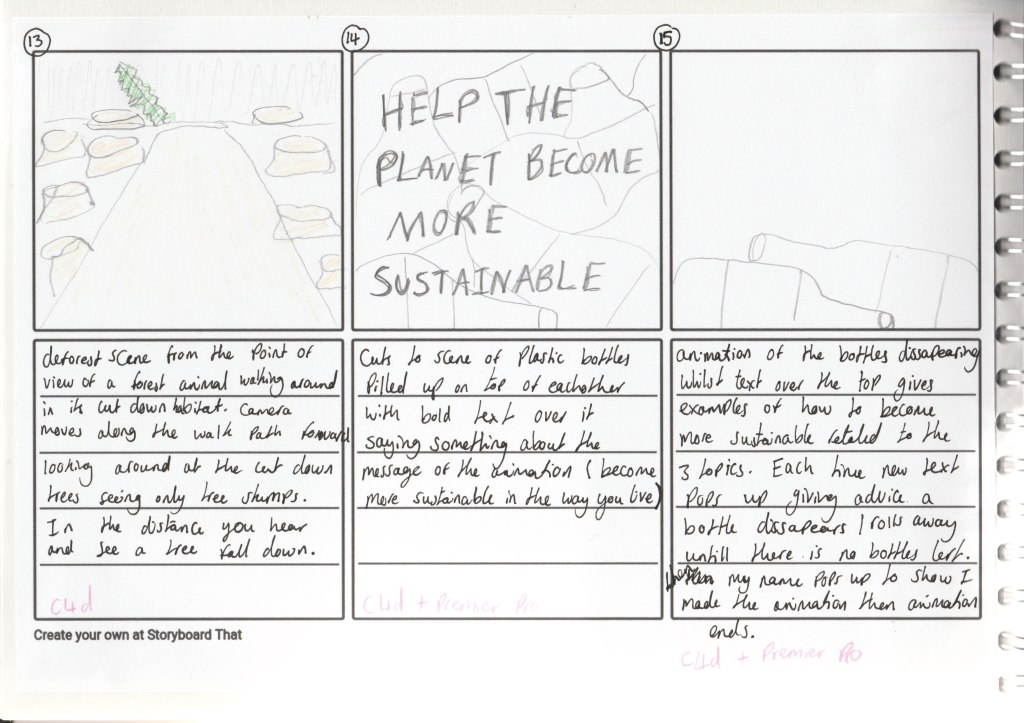
I drew out detailed storyboards to help me when it came to making the animations.

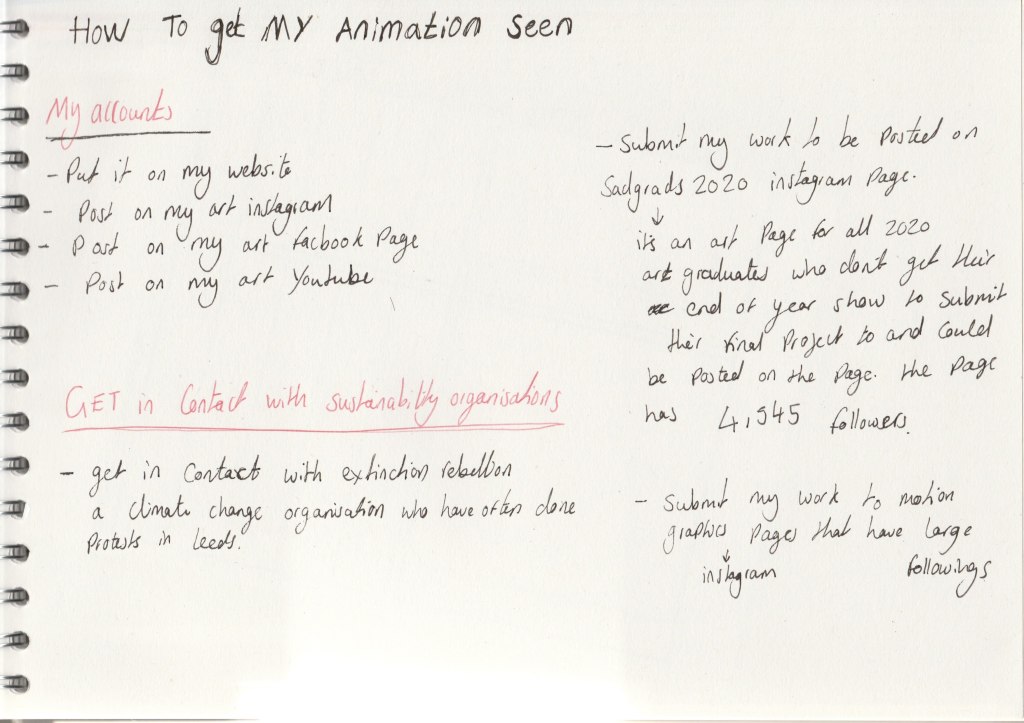
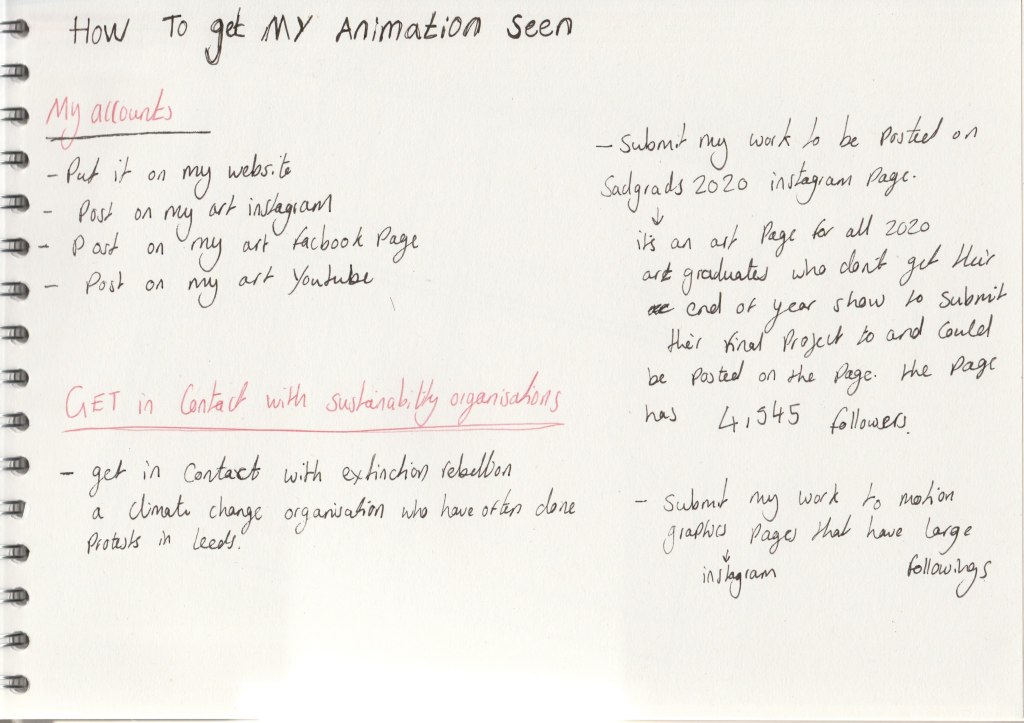
My animation will be posted on my social media accounts, I am also wanting to get in touch with organisations that focus on sustainability to see if my animation would be any use for them using it as part of their campaign. Because my animation will be posted on social media my target audience is age 16+. My target audience age is a large range as people of all ages care about climate change and for us to reduce climate change we need people of all ages to act.

Standard
Research.

Friends Of Earth- How to reduce plastic in the ocean

https://friendsoftheearth.uk/plastics

What is plastic pollution?

Plastic pollution is any plastic that ends up in the environment – from bottles and bags to less obvious sources like teabags and clothes.

In the past 100 years humans have produced (and used) a lot of plastic. It’s cheap, strong, light and versatile, but all of it eventually ends up in the ground, in the air , and in the sea – which is where marine animals like albatross, dolphins and turtles ingest it.

Our plastic waste has invaded the highest mountains and deepest oceans. No one knows exactly how long it will take to disappear, but it’s at least hundreds of years.

How does plastic harm the environment?

Plastic sticks around in the environment for ages, threatening wildlife and spreading toxins. Plastic also contributes to global warming.

Almost all plastics are made from chemicals that come from the production of planet-warming fuels (gas, oil and even coal).

Our reliance on plastic therefore prolongs our demand for these dirty fuels.

Burning plastics in incinerators also releases climate-wrecking gases and toxic air pollution.

Plastic in the food chain

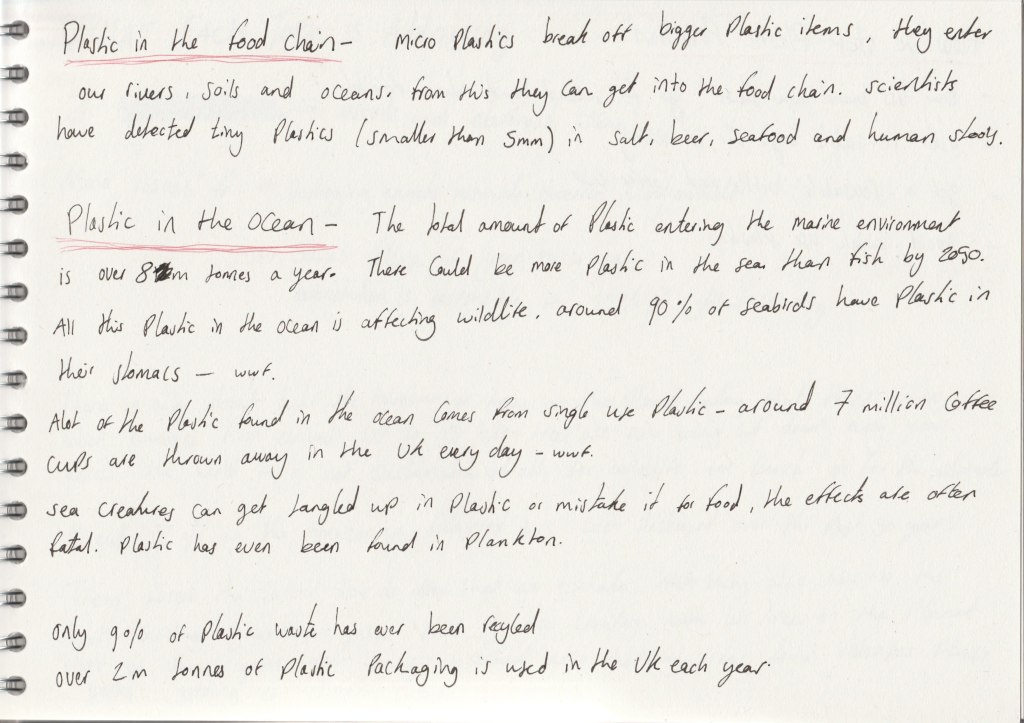
Scientists have detected tiny plastics (smaller than 5mm) in salt, beer seafood  and human stools.

These microplastics break off bigger plastic items, or come from products like car tyres and cosmetics. They even wash off synthetic clothes.

Once they enter our rivers, soils and oceans, they can get into the food chain. As of yet, the impacts on our health are unknown.

How to stop plastic pollution

  • Support a new law to phase out non-essential plastics.
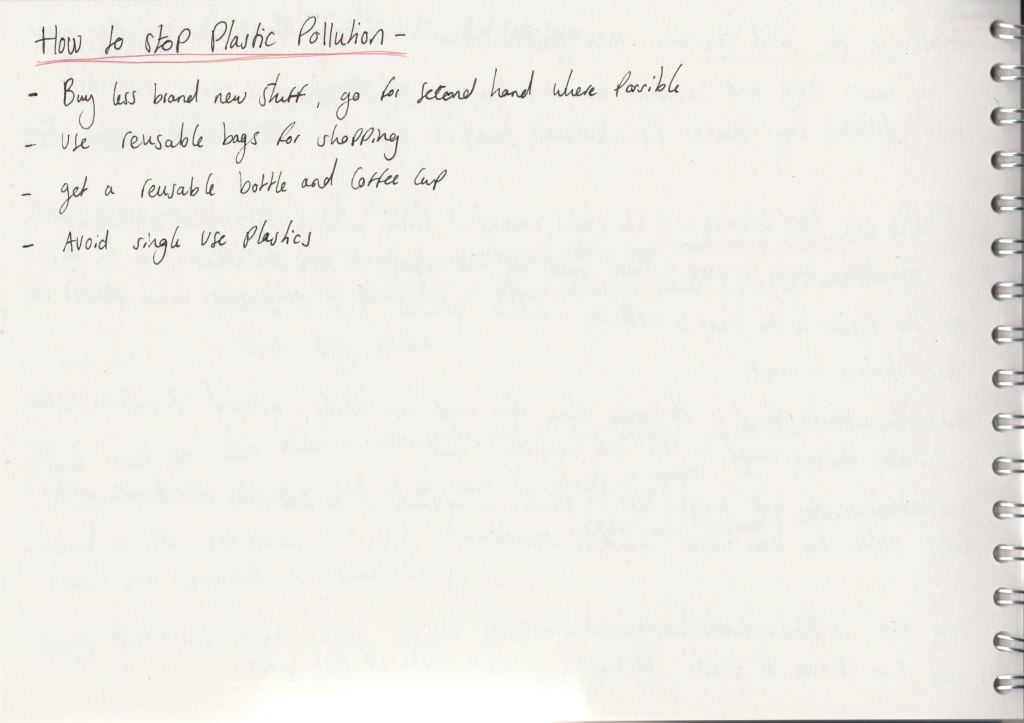
  • Buy less stuff (go for second-hand where possible).
  • Use reusable bags for your groceries.
  • Get a reusable bottle and coffee cup.
  • Make a packed lunch instead of buying sandwiches.
  • Wash your clothes at low temperatures.

What happens to recycled plastic?

Plastic is usually recycled into a lower-grade product. For example, a plastic bottle is likely to be made into polyester, which may then end up in a fleece jumper. Sounds good, but that fleece will shed tiny plastic fibres that will get into the environment and spread pollutants. So recycling plastic just delays the inevitable escape of pollutants into our soils, air, seas and waterways.

That’s why we’re campaigning for a new law to phase out all but the most-essential plastics.

How much plastic is in the ocean?

The total amount of plastic entering the marine environment is over 12m tonnes a year  – according to a report by Eunomia in 2016. For comparison, a double-decker bus weighs about 12 tonnes.

Sea creatures can get tangled in plastic or mistake it for food, and the effects are often fatal. Harmful chemicals linked to plastic have been found in species from plankton to dolphins.

Plastic pollution facts

Standard
Research.

Friends Of Earth- Live sustainably, how to be a conscious consumer

https://friendsoftheearth.uk/climate-change/live-sustainably-how-be-conscious-consumer

Excessive consumption drives climate change, which in turn further damages nature. Reduce your impact with these top tips.

1. Eat less (and better) meat and dairy

You might be surprised to discover that farming animals is one of the biggest contributors to climate change.

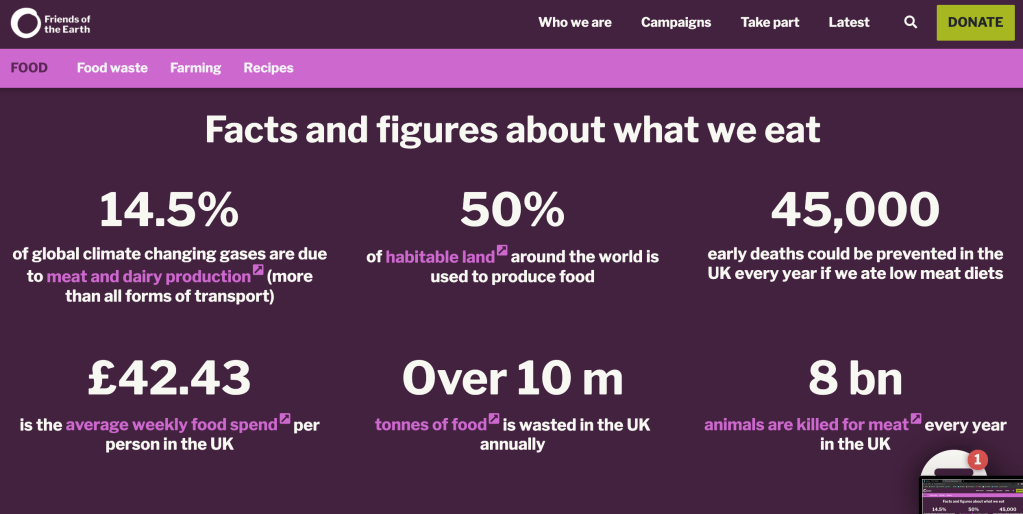
Meat and dairy production causes 14.5% of planet-warming gases.

Rainforests are being felled to make way for soya, most of which is being used to feed factory-farmed pigs and poultry.

Eating less meat and dairy can free up land for more tree planting and forests – good for nature and for tackling climate change.

2. Avoid palm oil

Palm oil is cheap to cultivate, which is why it’s used in so many of the products we buy.

When David Attenborough recently returned to Indonesia he was shocked at how much forest had been replaced by oil-palm plantations.

12.5% of Southeast Asian forest has been destroyed to make way for palm oil and other commodities. The iconic orangutan lives in these forests. As its habitat disappears, so too does its chances of survival.

Palm oil is widely used in lots of products, including cosmetics, shampoos, margarines, bread, crisps, ice cream and cleaning products.

3. Reduce food waste

That feeling you get when you throw food out. Not good, right?

10 million tonnes of food goes to waste in the UK every year. That’s as weighty as about 790,000 double-decker buses.

4. Buy less stuff

Most of us could probably do with less stuff in our lives.

Unfortunately we’re hardwired to feel good about getting something new. Retailers feast on this weakness, tempting our pleasure receptors with upgrades and sales.

Rising demands for raw materials to make these things – like oil, metals and water – are damaging the environment.

Buy and sell unwanted goods using websites like Shpock, Gumtree and Ebay.

5. Use good wood

Our country imports a lot of products made from wood – like paper and furniture. It takes an area of land almost 3 times the size of Wales to grow all that wood.

First, try to buy reclaimed or pre-loved wooden furniture wherever possible, and recycled paper products. Next best is to buy wood and wood products from UK or EU sources. If that fails, the Forest Stewardship Council (FSC) logo is your next option, but the scheme has not been without its troubles.

Why trees are great

Trees remove planet-warming carbon dioxide (CO2) from the atmosphere.

The Amazon produces a lot of the oxygen we need to breathe.

Tropical rainforests are one of the most wildlife-rich habitats in the world.

Trees give us shade, clean up air pollution, and provide wildlife habitats.

In rural areas trees can hold back flood waters and prevent soil erosion.

6. Reduce plastic pollution

It’s impossible to go for a walk without finding plastic waste: from crisp packets to bottles and bags.

But some forms of plastic aren’t even visible to the naked eye. Around a third of our clothes contain tiny plastic threads. When washed they can escape into the sea and end up in the stomachs of fish.

The problem of plastic pollution is now big news. Images of sea life entangled in our plastic waste are being broadcast around the world. It’s an issue that politicians can’t avoid.

7. Eat less (and better) fish

Our seas are much emptier than they used to be because of overfishing.

Some types of fishing are particularly harmful. Mangrove forests are cut down to make way for farming prawns, and dynamite fishing damages coral reefs.

Buy sustainable fish – and eat less of it to help lower the demand for fishing. Look out for certification by the Aquaculture Stewardship Council  (ASC) or the Marine Stewardship Council  (MSC). For help choosing sustainable seafood, see the Good Fish Guide .

Fish farming is rapidly increasing, leading to serious environmental harm. Coral reefs are also being overfished. Dynamite fishing damages the coral and kills all the fish in the area – including juvenile fish which then get discarded.

8. Share and donate

From cradle to grave, the stuff we buy has a big carbon footprint. Secondhand is a greener option.

Freecycle  is great for giving and getting free stuff locally. And you’ll find affordable prices at community furniture stores and charity shops.

Consider pooling resources with your neighbours so that you can share things like lawnmowers and power tools – you could even start a car pool.

9. Buy from sustainable businesses

As manufacturers and retailers strive to provide us with the cheapest possible products, they cut corners – harming people and the planet.

It’s often the poorest in the world who bear the main brunt.

So when you do buy new, look for brands that are transparent about the materials they use and the working conditions of their employees. Get more informed with our partner Ethical Consumer magazine, which provides 130 detailed product guides which subscribers can customise according to personal concerns.

10. Recycle and compost your waste

What has waste got to do with global warming?

More than 50% of our waste gets sent to landfill or burnt in incinerators. Both release planet-warming gases into the atmosphere.

It’s much better to recycle and compost. For example, 20 times more energy is used to make a new can than one from recycled sources.

Though buying less stuff or buying second-hand is even better.

Mining materials to make new products causes climate pollution. Recycling lowers the demand for these damaging materials.

Methane is a climate change gas. Composting reduces methane emissions from landfill and enriches soil for growing plants and food.

Standard
Research.

Friends Of Earth- Food and the environment

About friends of earth-

Friends of the Earth England, Wales and Northern Ireland is a grassroots environmental campaigning community. From our campaigners and lawyers to local groups and supporters, we push for change on causes that matter to you:

  • Protecting your home and local environment.
  • Adopting alternative energy solutions.
  • Fighting for environmental and social justice globally.

https://friendsoftheearth.uk/food?gclid=CjwKCAjwv4_1BRAhEiwAtMDLsj-UDHVWU2x14R-0qdulGoJyWIpY0q6R1JhMLvhzH7WW0ZD_dKErxBoCnPkQAvD_BwE

What’s wrong with our food?

1. Meat and dairy production takes up a whopping three quarters of all the available agricultural land in the world

One third of that land is used to grow animal feed such as soy — that’s an awful lot of land being used to inefficiently feed animals rather than directly feed people. And meat consumption is predicted to go up. The world is expected to be eating 76% more meat globally by 2050 than it did in 2005.

2. Producing livestock for human consumption contributes 14.5% of annual global greenhouse gas (GHG) emissions

So if we’re going to tackle climate change, we need to reduce the amount of meat and dairy we eat.

3. If all of us in the UK switched to the World Health Organisation’s healthy daily diet , we’d save 15 gigatonnes of GHG emissions by 2050

That’s around a third of the entirety of global GHGs emitted in 2011. Tackling climate change is also incredibly important for making sure the world is able to produce enough food – this is known as global food security. Extreme weather caused by climate change, rising sea levels, desertification and increased pressure from pests and disease, all threaten our ability to feed ourselves.

4. It’s not just meat and dairy that’s the problem

Our taste for fish has been stripping the seas. More than 70% of the world’s fish stocks are over- or fully exploited. Fish like tuna are disappearing from oceans – a tragedy not only for marine life but for the millions of people who rely on small-scale fishing for food and jobs.

Change what you buy and eat

We’ve all got to eat less, and better, meat and dairy

You don’t have to entirely drop meat and dairy from the shopping list for a planet-friendly diet. Start by reducing the amount you eat, making sure that what you’re eating is the best quality you can afford. Replace meat with plant proteins like beans, nuts and pulses, or meaty mushrooms.

Free-range is an animal welfare label for chicken and eggs, recognised in law

It means chickens have spent at least part of their lives outside. Free-range chicken typically contains less fat than intensively reared chicken, as well as being tastier.

MSC certified applies to seafood from sustainable sources

It is certified by the Marine Stewardship Council. It means producers don’t overfish and do look after the marine environment.

RSPCA-assured labels guarantee higher animal welfare standards

Certification applies to animals raised to welfare standards approved by the RSPCA.

Fair trade labels can be found on anything from bananas and chocolate to t-shirts and gold

Fair trade sets minimum ethical standards. It means farmers are paid a fair price for their goods, which are made under decent working conditions.

Effect farming has on our environment

Intensive farming is linked to loss of wildlife, soil and water pollution, and poor animal welfare.

Some people say it’s the only way to feed a growing world population at a time when climate change, soil degradation and water shortages are threatening food production.

But we don’t need factory farms, loads of chemicals or genetically modified seeds to feed a growing population.

We need to improve the ways we produce food – and learn from farmers in the UK and abroad who are cutting their emissions, restoring their soils and protecting their local ecosystems. We also need to eat more plants, less and better meat (and dairy), and waste less food. Our food and farming system needs a healthy environment, and must play its part in building one.

What’s the problem with pesticides and fertilisers?

Some farmers use pesticides to try and keep insects and other bugs away from their crops. But pesticides harm our wildlife and environment , and add toxins into the food chain.

Some pesticides harm bees – and we rely on bees to pollinate our food. Pesticides can also affect the health of farm workers  – causing severe and sometimes fatal illness.

Farmers often also use fertilisers to add nutrients to their soils and help crops grow faster. But too much synthetic fertiliser can lead to pollution of local streams and rivers with nitrogen, killing fish and plant life.

We know that there are some great farmers out there. They’re maintaining healthy soils that don’t need fertilisers, and managing bugs and diseases the natural way. That’s great news for their health, our tastebuds and the environment.

Genetically modified food – what’s wrong with it?

Genetically modified (GM) foods are produced by changing the genetic make-up of crops and other plants to alter their characteristics.

Despite promises of miracle crops, GM technology has failed to increase food yields and it’s made the problems caused by intensive farming worse. They benefit big farmers and biotech corporations – not us.

We think it would be a mistake to grow GM crops commercially in the UK. We need a farming approach that works with nature, not against it. GM crops are not needed for future food production [PDF].

People have a right to eat GM-free food, but a loophole in our labelling laws means that milk, meat and eggs from GM-fed animals are not labelled .

Animal welfare

Just like humans, animals need access to food and water, good quality housing and safe living conditions, free from fear or pain. They should be able to go outside, move around freely and eat a natural diet.

Many farmers understand that providing these conditions benefits the animals and is better for the environment .

The UK has laws to protect farm animals, but they aren’t perfect. Many intensive farms still keep animals in conditions that encourage disease and discomfort .

New trade agreements could see our supermarkets selling more low-welfare products unless we protect food standards  after Brexit.

Make sure all your meat is RSPCA Assured – and buy organic when you can – to support farmers who treat their animals well.

Is there a problem with factory farms?

Factory farming involves raising animals in large numbers (and at high density) in a factory-like environment. It’s also called ‘intensive farming’.

The aim of factory farming is to produce as much meat, eggs or dairy at the lowest possible cost.

It needs high volumes of cheap animal feed – which has been linked to deforestation around the world. And all that livestock means lots of waste, which can pollute local soils and water, damaging biodiversity and killing fish. Some 30% of thenitrogen that pollutes water in the EU [PDF]  comes from livestock.

Intensive farms also rely on antibiotics and pesticides to prevent disease in crowded conditions. This means intensive farms don’t offer a healthy environment for the animals living there.

And factory farming isn’t just bad for the environment and animal welfare. It’s bad for our health. Studies have shown that intensively produced meat contains less vitamins and more unhealthy fats [PDF]  than pasture fed, extensively raised animals. Plus, people living near factory farms have reported health problems linked to the huge amounts of manure the farms produce, which is often spread on nearby fields.

Animals and antibiotics – is there a risk?

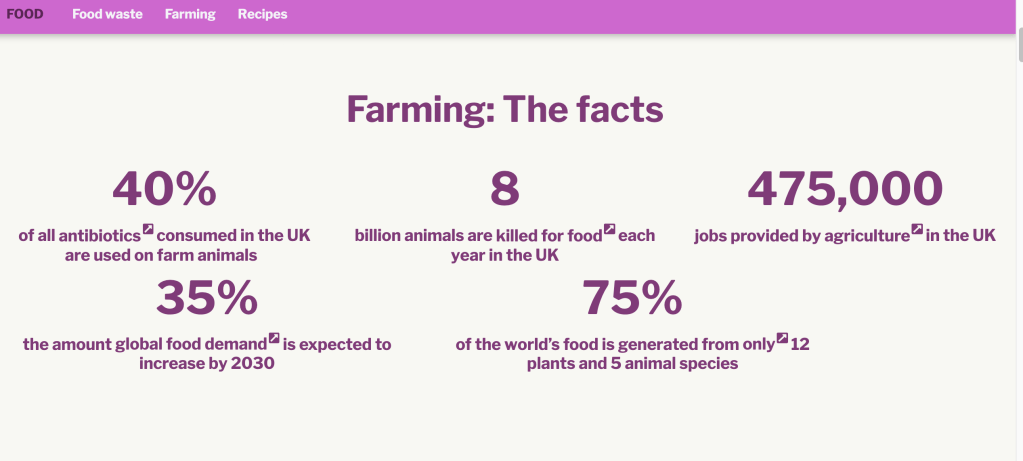
30% of all antibioticsconsumed in the UK are used on farm animals. And most of the time, these animals aren’t even ill. Sounds like a waste, doesn’t it?

It gets worse. Using antibiotics at low doses before the animal even becomes ill is causing big problems. Resistant strains of bacteria are evolving, leading to some antibiotics becoming less effective. That means that giving antibiotics to pigs, cows, sheep and chickens is making it harder to treat humans for serious diseases.

And why give antibiotics to so many animals? Intensive farms rely on antibiotics to prevent their animals getting ill in cramped, low-welfare conditions. If using antibiotics like this were banned, farms would need to treat their animals better and give them more room.

We think sick animals should be treated with the right drugs to make them better. But healthy animals shouldn’t.

Choose organic meat to be sure you’re not supporting inappropriate antibiotic use – and help save these important treatments for the people who need them.

Standard
Research.

Extinction Rebellion- Climate change activists

Extinction Rebellion is an international movement that uses non-violent civil disobedience in an attempt to halt mass extinction and minimise the risk of social collapse.

“We are unprepared for the danger our future holds. We face floods, wildfires, extreme weather, crop failure, mass displacement and the breakdown of society. The time for denial is over. It is time to act.

Conventional approaches of voting, lobbying, petitions and protest have failed because powerful political and economic interests prevent change. Our strategy is therefore one of non-violent, disruptive civil disobedience – a rebellion. 

Historical evidence shows that we need the involvement of 3.5% of the population to succeed – in the UK that’s about 2 million people.”

Standard
Research.

How to encourage people to take action – Persuasive advertising

https://www.studiobinder.com/blog/ethos-pathos-logos/

How to persuade my audience to act on the issue of sustainability

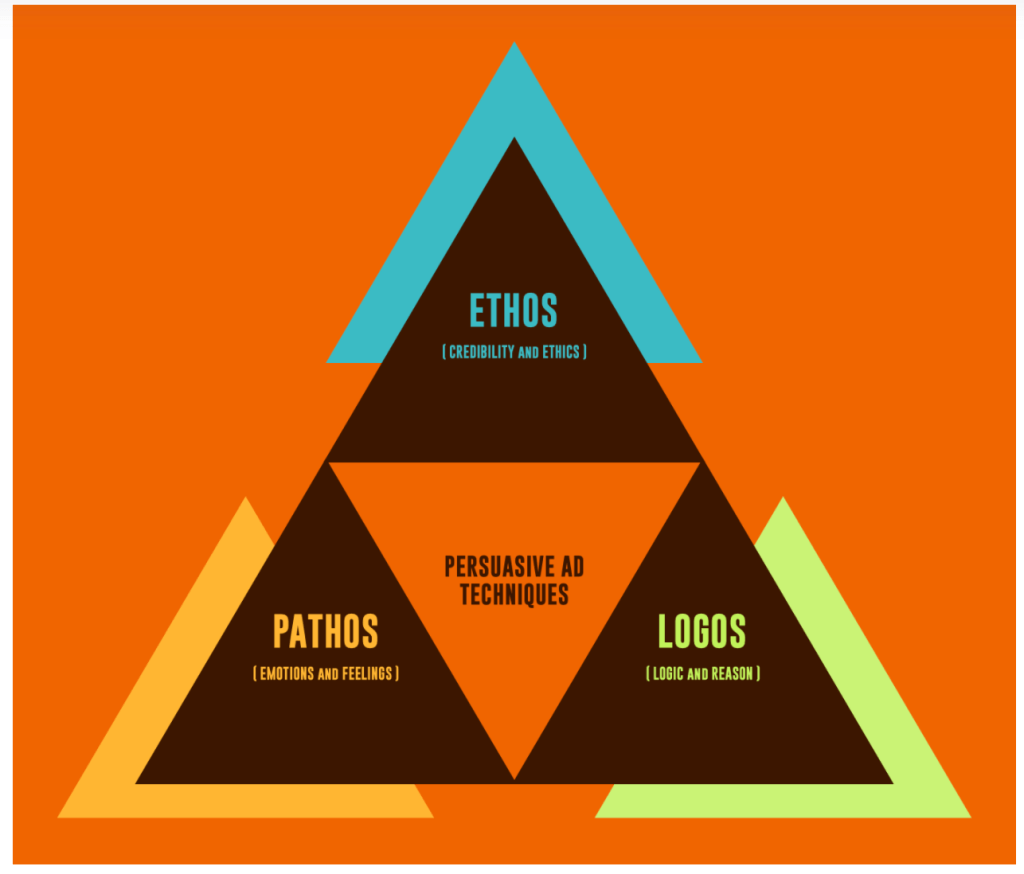
Ethos calls upon the ethics, or what we’d call the values, of the speaker. Pathos elicits emotions in the audience. Finally, logos puts logic into play by using evidence and facts.

Ethos:

Ethos is the persuasive technique that appeals to an audience by highlighting credibility.

Through respect, the spokesperson appears convincing, authoritative and trustworthy enough to listen to. Of the types of persuasive techniques in advertising, ethos is best used to unlock trust.

Pathos:

Pathos is persuasive technique that try to convince an audience through emotions. Pathos advertisement techniques appeal to the senses, memory, nostalgia, or shared experience. Pathos examples pull at the heartstrings and make the audience feel.

A quick way to appeal to a viewer’s emotions? A cute animal. A devastated family. A love story. Overcoming great odds. An inspirational song and imagery. 

Pathos appeals to an audience’s basic emotions like joy, fear, and envy. All are easily triggered in many ways.

If you want to explore pathos in advertising, language is the best place to start. Why? Because the words we hear and read trigger specific feelings. Positive words conjure feelings of love, excitement and wonder.

Look at how General Mills and Cheerios achieved this in their “Good Goes Round” campaign. We see sunshine, smiles and bright colors while we hear the words “good goes around.” It invites positivity and encourages us to associate Cheerios accordingly.

Band waggon Advertising

“Bandwagon advertising” is commonly categorized under pathos advertisement examples. It creates that impression that using certain product will put you on the “winning team”. It adheres to the pathos definition because it plays off your fear… of being left out.

Old Spice used this in their “The Man Your Man Could Smell Like”

Of the persuasive advertising techniques, “Bandwagon” puts your brand on the right side of popular opinion.

Logos

Logos is the persuasive technique that aims to convince an audience by using logic and reason. Also called “the logical appeal,” logos examples in advertisement include the citation of statistics, facts, charts, and graphs.

Technology advertisements use logos because their goal is to showcase cool new features. Consider the example of logos in Apple’s advertisement for the iPhone X:

Of the types of persuasive techniques in advertising, logos will build your brand as the most logical, functional and helpful option.

Wrapping up ethos, pathos, logos

When browsing the many types of persuasive techniques in advertising, consider what your user needs from you. Then ideate on which technique can best fulfill that need.

the brand should guide how the persuasive advertising techniques are deployed. What is the company known for? What does it stand for? 

Standard
Research.

Charity campaigns that used humour

World Down Syndrome Day

To mark World Down Syndrome Day in 2017, Down Syndrome International released a PSA jokily explaining why the term ‘special needs’ does not make sense in relation to people with the condition.

the ad brings to life what a number of ‘special needs’ might actually be, such as eating dinosaur eggs or being woken up by a celebrity each morning. But in reality, while they might need a little extra assistance in some areas, people with downs syndrome simply have the same needs – including love, friendship, and a career – as everyone else.

Touching and funny – the campaign is effective at using humour to break down common preconceptions. It also highlight’s the charity’s initiatives, encouraging people to visit its campaign website in order to find out more about the real lives of people with down syndrome.

Coppafeel

Coppafeel talks about breast cancer. Essentially, it aims to empower women by talking about a serious topic in a light-hearted and unexpectedly fun way.

Informing viewers that ‘touching your boobs could save your life’, its 2017 ad explained the various ways people can check themselves, illustrated with a variety of objects and food items designed to look like breasts.

Balls to Cancer & Volkswagen’s ‘Working with you’

The aim of the charity Balls to Cancer is to ‘fight testicular cancer with fun’. It speaks about the topic of testicular cancer in a decidedly jokey way, mainly to appeal to men who might be embarrassed or shy away from the subject.

This year, it has teamed up with Volkswagen to raise awareness during Male Cancer Awareness Month, creating an ad to urge people to take care of their health as much as they do their vans. 

Standard
Research.

How to communicate the issue that change is needed to an audience

Article: The science behind why people give money to charity- The Guardian

https://www.theguardian.com/voluntary-sector-network/2015/mar/23/the-science-behind-why-people-give-money-to-charity

Hearts over heads:

Many people are aware that they should donate to the causes that have the highest impact, but facts and figures are less attractive than narratives. In a series of experiments, it was found that people are much more responsive to charitable pleas that feature a single, identifiable beneficiary, than they are to statistical information about the scale of the problem being faced.

Influenced by others:

Another of the major takeaways from the research in this area is that giving is fundamentally a social act. One study shows that people give significantly more to their university if the person calling and asking for their donation is their former roommate. Researchers found that when JustGiving donors see that the donor before them has made a large donation, they make a larger donation themselves.

It’s not just out friends and families who can influence us. Donors to an international development charity were more likely to respond to a match–funding campaign if they knew that that the match came from the Bill and Melinda Gates foundation than if it came from an anonymous source.

Article: Emotive charity advertising, has the public had enough? – The Guardian

https://www.theguardian.com/voluntary-sector-network/2014/sep/29/poverty-porn-charity-adverts-emotional-fundraising

Co-founder of Regarding Humanity, Linda Raftree believes that adverts we’ve previously been used to seeing – of hopeless people in poverty – aren’t effective in solving the issues charities are seeking to address. They don’t empower or create sustainable change, she says.

She is part of the Rusty Radiator Awards panel – a Norwegian initiative which takes a comical look at charity videos that overdo stereotyping. – https://www.radiaid.com/

The awards were founded in 2013 after a tongue-in-cheek Africa for Norway video created by The Norwegian Students’ and Academics’ International Assistance Fund (SAIH) became a viral hit.-

“When we start to think that we are so substantially different from other people, it becomes easier to accept that people are suffering – we believe these images that are shown in advertising and fundraising campaigns create apathy rather than action,” he says.

Being humorous, creative, or both, without over-simplifying the issues and also showing the structural reasons behind poverty, is the way forward, he says. “Humour is universal”

“The public now responds much better if they can follow a concrete and tangible impact in a charity advert,” she says. “The most effective charity adverts feature just one person. If the advert shows just one single person, it feels more real and therefore has more of an impact.”

Standard